
The Upkeep Restoration Protocol: A Layton-Specific Approach to Water Damage
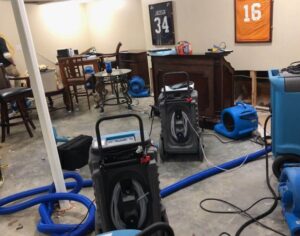
When your property is damaged by water, you need more than a generic checklist. You need a disciplined, site-specific protocol executed by technicians who understand the unique environmental pressures facing homes in Layton, Utah. From the expansive clay soil in West Layton neighborhoods to the hydrostatic pressure caused by spring snowmelt off the Wasatch Front, our process is built on a decade of first-hand experience mitigating water damage restoration in Davis County.
Our technicians are not just trained; they hold IICRC certifications in Water Damage Restoration (WRT) and Applied Structural Drying (ASD), the gold standard in our industry. Review our IICRC certifications and credentials to see the full scope of our qualifications. We follow the ANSI/IICRC S500 Standard not just as a guideline, but as a rigid protocol for every job, from a supply line break in an East Layton home to a foundation leak near Antelope Drive. For a real-world example of this protocol in action, see how we handled a burst pipe in Layton.
Step 1: 60-Minute Arrival & On-Site Triage for Layton Properties
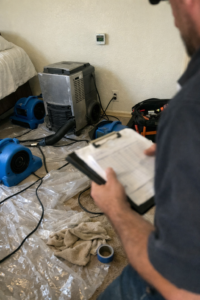
A water damage event is a tactical emergency. Our response is immediate, with a technician on-site within 60 minutes for properties across Layton and surrounding communities like Kaysville, Syracuse, and Clearfield. The first priority is stopping the source. The second is a detailed assessment to classify the water and damage using water damage categories and classifications as defined by the IICRC — covering Category 1, 2, and 3 water sources and Class 1 through 4 damage levels. This initial triage is critical; it dictates the entire scope of work, from required PPE to the specific drying strategy. We document pre-existing conditions and the water’s migration path using thermal imaging and moisture meters, providing a clear baseline for you and your insurance carrier. For immediate help, visit our emergency services.
Step 2: Rapid Extraction with Truck-Mounted & Submersible Pumping
Removing bulk water quickly is non-negotiable to prevent it from wicking into drywall and seeping into subfloors. Our response vehicles are equipped with both truck-mounted extraction units for widespread flooding and portable submersible pumps for contained areas like basements and crawl spaces. For a common scenario in the area, like a basement flooded by snowmelt, our first step after assessment is deploying submersible pumps to manage the standing water. This rapid de-watering minimizes absorption into porous concrete and framing, reducing the overall drying time and structural impact. See our water extraction services and basement flooding solutions.
Step 3: Moisture Mapping: Finding Hidden Water in Layton’s Varied Home Construction
Water travels. It hides in wall cavities, under vinyl flooring, and within the insulation of homes from every decade. We use non-invasive tools, including Protimeter SurveyMaster moisture meters and FLIR thermal cameras, to map the full extent of the intrusion. This process is meticulous. We check behind baseboards, inside closets, and at the sill plates where the foundation meets the home’s wood frame, a common entry point for moisture in homes built on Layton’s clay-heavy soil. This detailed moisture map becomes our guide for placing drying equipment and our proof of loss for your insurance claim. Learn more about our moisture detection process.
Step 4: The Science of Drying: Our Layton-Specific Psychrometric Strategy
Effective drying is about manipulating the environment. We use the science of psychrometrics to create a vapor pressure differential that pulls moisture from wet materials into the air. Our IICRC ASD-certified technicians deploy a calculated setup of Phoenix and Dri-Eaz LGR (Low-Grain Refrigerant) dehumidifiers and Dri-Eaz Velo Pro air movers to accelerate evaporation. You can learn more about our LGR dehumidifiers and our dehumidification process and our full suite of structural drying services.
In Layton, drying isn’t one-size-fits-all. A home in a newer development west of I-15 with a vapor barrier requires a different approach than a 1980s brick home in East Layton with hygroscopic (moisture-attracting) materials. We establish a drying goal based on the material’s equilibrium moisture content (EMC) and monitor our progress with daily psychrometric readings, ensuring we return your home to a stable, dry standard without over-drying materials.
Step 5: Post-Drying Sanitization & Air Quality Control
Once materials are verified as dry, we focus on sanitation. For Category 2 or 3 water (grey or black water), we apply an EPA-registered antimicrobial agent to affected surfaces to prevent microbial growth. To address airborne particulates and odors, we use Dri-Eaz DefendAir HEPA 700 air scrubbers as part of our HEPA air scrubbing and filtration service, which captures 99.97% of airborne particles down to 0.3 microns. This is a critical step after any water loss to ensure the indoor air quality is safe for your family. Additional services like post-flood odor removal services and professional mold remediation are also available.
Step 6: Reconstruction & Repair: Returning Your Property to Pre-Loss Condition
Our mission ends only when your property is fully restored. Operating under our state license 920347-5501, our reconstruction team handles everything from drywall repair and replacement and insulation to flooring removal and replacement and cabinetry. We also coordinate contents cleaning and pack-out services to return your personal belongings to pre-loss condition alongside the property itself. We document every repair to provide your insurance adjuster with the necessary evidence for your claim. Our goal is to make the property feel like the damage never happened. Learn more about our reconstruction services and insurance claims assistance.
Why Our Process is Different for Layton’s Unique Challenges
Any company can own drying equipment. Few have the localized experience to use it effectively in Davis County.
- Expansive Clay Soil: In neighborhoods like Chelsie Park or new developments west of town, the soil heaves and shrinks, stressing foundations. We are experts at identifying foundation cracks as the source of intrusion and know that simply drying the basement isn’t enough.
- Wasatch Front Snowmelt: The sheer volume of spring runoff creates intense hydrostatic pressure. We’ve managed dozens of incidents in Fruit Heights and surrounding communities where this pressure forces water through even minor foundation imperfections. Review our recent water damage job in Layton for a representative example of how we respond to fast-moving residential water events.
- Winter Ice Dams: The freeze-thaw cycles common in Northern Utah lead to ice dams that force water under roofing and into attics and wall cavities. Our thermal cameras are essential for tracing these elusive, slow-moving leaks — see how we traced an ice dam water intrusion in Kaysville using exactly this approach.
We Hold Ourselves Accountable: IICRC Standards & Full Transparency
We are a Layton-based firm, and our reputation in this community is everything. We carry a general liability insurance policy of [$300,000 aggregate] as required for licensed contractors in Utah and are registered with the Utah Division of Corporations under our legal business name Upkeep Water Damage Restoration. From the first call to the final walkthrough, our process is defined by the IICRC S500 standard, transparent documentation, and a deep understanding of how to provide thorough water damage restoration in Layton, UT. For more information, visit our contact page or check our FAQs.