
Loss Type: Mold Remediation / Chronic Moisture Intrusion
Location: Central Layton, UT near Main Street corridor
Response Time: Next-day scheduled
Job Duration: 3 days
Insurance: No – homeowner self-pay
The Situation
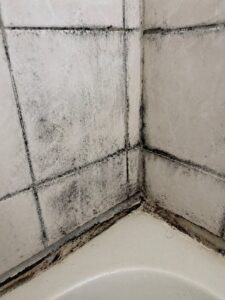
A homeowner near Layton’s Main Street corridor contacted us after noticing dark staining along the grout lines of their master bathroom shower and a musty odor that had developed over several months. They had been treating the surface with store-bought mold spray without lasting results. An initial inspection confirmed the issue extended beyond the tile surface — mold remediation was necessary because mold had colonized the drywall behind the shower wall due to a chronic caulk failure at the tub-wall junction that had allowed moisture to penetrate the assembly over an extended period.
The Problem
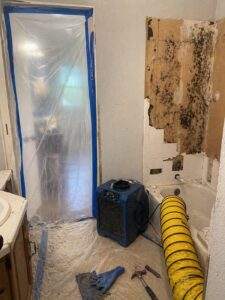
Surface mold treatment is ineffective when growth has penetrated into the drywall substrate. The failed caulk had created a chronic moisture pathway that kept the drywall behind the tile continuously damp — an ideal environment for mold colonization. Moisture readings behind the shower wall registered well above the threshold for mold risk, and visual inspection after removing two tiles confirmed black mold growth on the paper face of the drywall.
Because the home was owner-occupied with young children, we prioritized rapid containment before beginning any remediation work.
What We Did
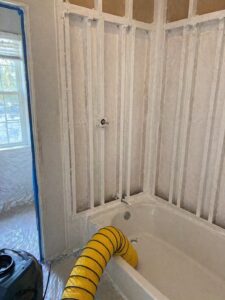
We established full containment of the master bathroom using 6-mil poly sheeting sealed at all openings, and introduced negative air pressure using a HEPA-filtered air scrubber to prevent spore migration to the rest of the home during work. Per IICRC S520 mold remediation standards, the scope included:
- Removal of approximately 18 square feet of mold-affected drywall behind the shower wall
- Wire brushing and HEPA vacuuming of all exposed framing
- Application of an EPA-registered mold encapsulant to all exposed wood framing
- Continuous air scrubbing with HEPA filtration throughout the remediation period
- Post-remediation clearance testing by an independent third-party inspector
The underlying moisture source — the failed caulk — was identified and documented for the homeowner’s contractor to address before tile replacement.
The Outcome
Post-remediation air sampling by the independent inspector confirmed spore counts within normal outdoor baseline levels. The homeowner’s contractor subsequently replaced the drywall, retiled the shower, and properly recaulked the tub-wall junction to eliminate the moisture source — the critical first step in long-term mold prevention. The musty odor was eliminated. We provided the homeowner with a written remediation report and clearance certificate for their records. See more of our work in our case studies.
“I’d been spraying that shower with bleach for months and it kept coming back. They found out why in about 20 minutes. The whole process was clean, contained, and they tested everything before they left. Haven’t had a trace of mold since.”
— S. and B. Whitmore, Layton UT
Related Case Studies
If you found this project helpful, you may also want to read about our bathroom mold case in Fruit Heights or our attic mold remediation in Kaysville, both of which involved similar mold containment and clearance processes in Davis County homes.